
Introduction: Standing at the Edge of an Age
Many spiritual traditions speak of endings and beginnings, of ages that collapse so new worlds can be born. Today, we appear to be standing at such a threshold: ecological collapse, social fragmentation, and spiritual disconnection all signal a collective “Age of Destruction.”
Yet within this apparent ending, ancient prophecies, sacred symbols, and Indigenous Dreaming stories point toward something else emerging: a Rebirth of consciousness, often carried in the image of the Divine Feminine.
This post explores:
- How Kali, the goddess of death and destruction, signals the end of an age
- The biblical “woman” of Genesis 3:15 and Revelation as a prophetic archetype
- Academic reflections on the return of the Divine Feminine
- The Caterpillar Dreaming and Butterfly Dreaming are an Aboriginal vision of transformation and Rebirth
1. Kali and the End of the Age of Destruction
1.1 Kali: Mother of Endings and Beginnings
In Hindu tradition, Kali is often misunderstood as only a terrifying goddess of death and destruction. Yet for many devotees, she is also:
- The fierce mother who cuts away illusion
- The destroyer of ego and injustice
- The one who clears what is rotten so new life can grow
Her garlands of skulls, her lolling tongue, her dance on the chest of Shiva — all symbolise the dismantling of what no longer serves life.
1.2 The Collective Kali Moment
When we look around today, we can see Kali’s symbolism playing out on a global scale:
- Old systems of power are cracking
- Hidden violence and oppression are exposed
- Ways of living that exploit the Earth are failing
In this sense, Kali can be seen as a mirror of our times: an archetypal force pushing humanity to confront its own Age of Destruction — not as a final annihilation, but as a necessary clearing.

2. The First Prophecy: The “Woman” of Genesis 3:15
2.1 The Enigma of Genesis 3:15
In the Hebrew Bible, Genesis 3:15 contains a mysterious and foundational prophecy:
“And I will put enmity between you and the woman,
and between your seed and her seed;
he shall bruise your head,
and you shall bruise his heel.”
Traditionally interpreted in many Christian contexts as a prediction of a coming saviour, this verse also foregrounds a powerful figure: the woman.
2.2 The Woman as Archetype
Beyond dogmatic readings, some see in this passage an archetypal drama:
- The serpent as a symbol of deception, domination, or distorted power
- The woman as bearer of a seed that will crush the serpent’s head — the ultimate triumph over destructive forces
In this view, the “woman” is not only a historical or future individual, but an image of:
- The feminine principle that resists corruption
- The womb of a new humanity
- The first biblical hint of a long arc of redemption
3. The Woman in Revelation: A Cosmic Sign
3.1 Clothed with the Sun
The Book of Revelation returns to this feminine figure, expanding her symbolism into cosmic proportions:
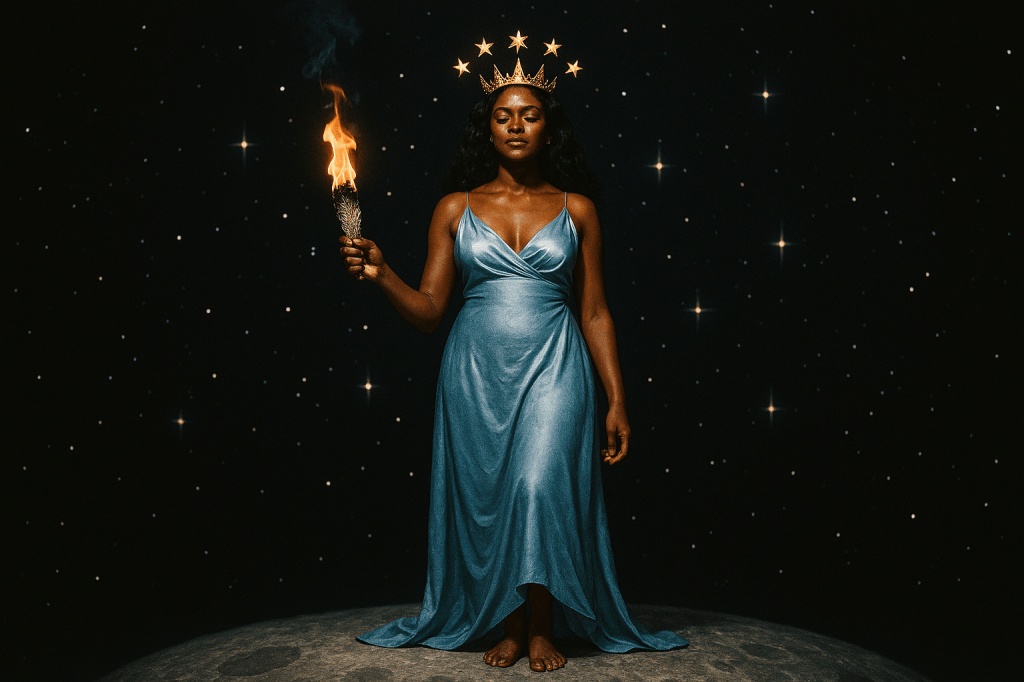
“A great sign appeared in heaven: a woman clothed with the sun,
with the moon under her feet and a crown of twelve stars on her head.” (Revelation 12:1)
Here, the woman appears:
- Radiant and crowned, standing between heaven and Earth
- Pregnant, crying out in the pains of birth
- Threatened by a dragon that waits to devour her child
3.2 Birth Amidst Conflict
This apocalyptic vision mirrors our time:
- A world in labour, trembling with contractions of crisis
- Powerful forces (the “dragon”) are trying to prevent a new consciousness from being born
- A feminine presence at the centre of transformation
For many mystics and interpreters, the woman of Revelation is not only an individual or institution, but a living symbol of the Divine Feminine giving birth to a new order — even as the old world resists.
4. The Return of the Divine Feminine in Modern Thought

4.1 Academic and Spiritual Rediscovery
Across theology, religious studies, depth psychology, and cultural theory, many academics and writers have traced a pattern: the re-emergence of the feminine in spiritual and cultural consciousness. They highlight:
- Recoveries of ancient goddesses and feminine imagery
- New readings of sacred texts that centre women’s voices
- Renewed respect for the body, the Earth, and relational ways of knowing
4.2 Why the Feminine Now?
The return of the Divine Feminine is not about replacing one dominance with another, but about rebalancing:
- Healing the split between spirit and matter
- Softening rigid hierarchies into mutuality and cooperation
- Holding paradox, ambiguity, and mystery instead of demanding total control
In a time when the “masculinised” aspects of culture — conquest, extraction, domination — have pushed the planet to the brink, the Divine Feminine arises as a corrective and a compass.
5. Caterpillar Dreaming: The Old Self and the Old World
5.1 The Caterpillar in Aboriginal Legend
In some Aboriginal traditions, the Caterpillar Dreaming speaks of a primordial time when ancestral beings moved across the land, shaping country, laws, and relationships between all forms of life. (Specific details vary by Nation and language group, and are held with deep cultural care and protocol.)
Within the broader archetypal symbolism, the Caterpillar represents:
- A creature bound to the ground
- A life dedicated to consuming and growing
- An identity that has not yet awakened to its final form
5.2 Humanity as Caterpillar
Our current civilisation often behaves like a caterpillar:
- Consuming resources without restraint
- Expanding endlessly without wisdom
- Living as if this stage is all there is
In this light, Caterpillar Dreaming becomes a mirror: we see ourselves as beings who have not yet remembered what we truly are destined to become.
6. Butterfly Dreaming: The Fulfilment and Rebirth
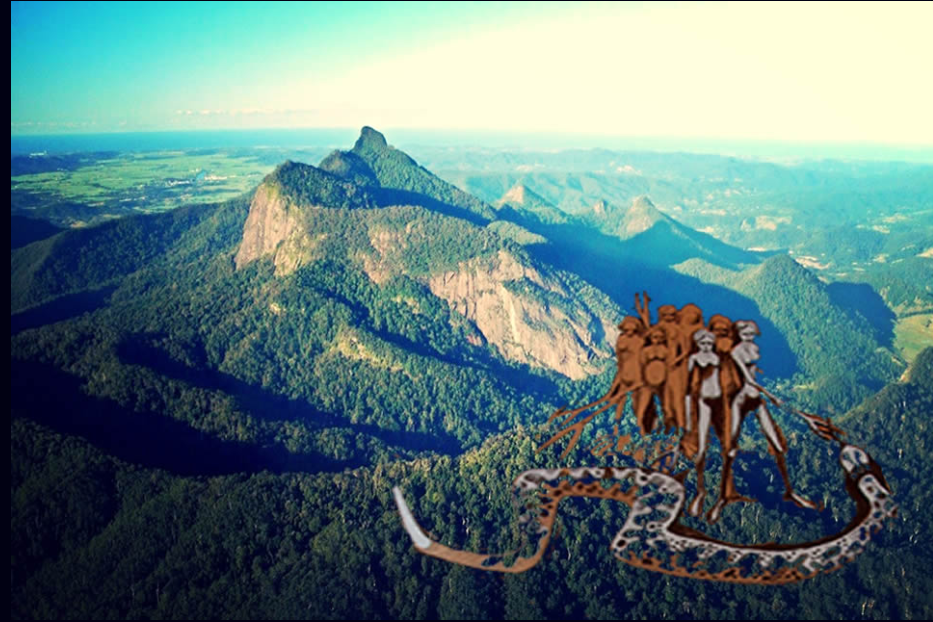
The Wollumbin Caterpillar Dreaming and the ancient serpent coiled in the Volcanic Caldera
6.1 The Cocoon of Crisis
The movement from Caterpillar to Butterfly requires a radical in-between: the cocoon. Inside it:
- The old body dissolves
- Familiar structures break down
- New forms are shaped in darkness
Our global crises — environmental, social, spiritual — can be seen as a kind of collective cocoon. Old identities, systems, and stories are disintegrating. What looks like pure destruction may, at a deeper level, be preparation.
6.2 Becoming New Creatures
In Butterfly Dreaming, the Caterpillar’s story does not end in death but in transfiguration:
- A grounded crawler becomes a winged being
- Consumption gives way to pollination and beauty
- Limited perception opens into a new dimension of existence
This “fulfilment” of Caterpillar Dreaming by Butterfly Dreaming beautifully encapsulates the idea of Rebirth: that we are invited to awaken as new creatures, capable of:
- Living lightly on the Earth
- Moving in a relationship rather than domination
- Seeing reality from a higher, more connected vantage point
7. Weaving the Threads: Kali, the Woman, and the Dreaming
7.1 Patterns Across Traditions
Placed side by side, these symbols form a single tapestry:
- Kali reveals the end of a destructive age and the cutting away of illusion.
- The “woman” of Genesis and Revelation signals a long-foretold breakthrough over forces that harm and deceive.
- The Divine Feminine returns in theology, scholarship, and lived spirituality as a balancing, healing presence.
- Caterpillar and Butterfly Dreaming portray the movement from blind consumption to luminous transformation.
7.2 One Story, Many Languages
Each tradition speaks in its own sacred language, but together they whisper a shared message:
- Destruction is not the final word.
- The feminine face of the Divine is rising once more.
- Humanity is being invited to shed an old skin and emerge as something new.
8. An Invitation to Personal Rebirth

8.1 Meeting Kali Within
The end of the Age of Destruction is not just geopolitical or cosmic; it is intimate and interior. Each of us is invited to:
- Let Kali cut away what is false in us
- Allow old identities to fall apart
- Face the “dragon” of fear, addiction, and control within
8.2 Saying Yes to the Woman and the Butterfly
To align with this, Rebirth is to:
- Honour the Divine Feminine in ourselves and others — in intuition, compassion, and embodied wisdom.
- Listen to the Earth and Indigenous voices that remember older ways of being in right relationship.
- Enter our personal “cocoons” of transformation, trusting that something more whole and more beautiful is waiting to emerge.
In the end, the nearing of the Age of Destruction may not be the collapse of everything, but the necessary cracking of an old shell so that what has long been prophesied — the Rebirth of humanity, led by the returning Divine Feminine — can finally spread its wings.
 Unveiling Earth Energies
Leave a comment